ZF launches 30,000 rpm e-drive: smaller, lighter, half the rare earths
ZF unveils a 30,000 rpm e-drive for mainstream cars, cutting size and weight about 25% and rare-earth magnets by half.
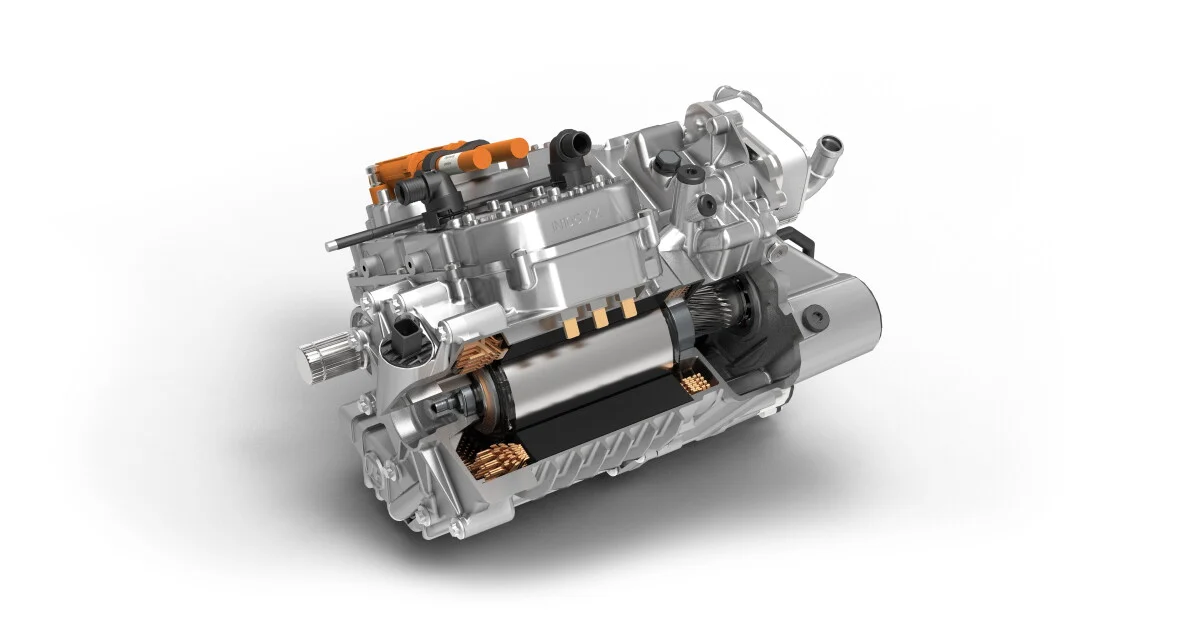
Most EV motors spin between a few thousand and just over 10,000 rpm, but German engineering giant ZF's newly unveiled High Revolution Drive pushes the number to 30,000 rpm. That works out to the rotor turning 500 times per second, or one revolution every 2 milliseconds.
This is not about building a track-spec monster. ZF says the complete e-drive, which integrates the inverter and reducer, aims to trade high speed for smaller size, lighter weight and half the rare-earth magnet content.
Image: The high-speed e-drive can cut size, weight and rare-earth magnet use while maintaining ordinary EV power. Image credit: ZF
Double the speed, less torque pressure
Motor power equals torque times speed. Conventional EV motors top out at around 18,000 rpm, and to get enough power engineers often need larger, heavier rotors packed with more expensive rare-earth magnets. Raising speed nearly twofold to reach the same power means the required torque drops noticeably, easing the burden on the rotor and magnets.
ZF uses a two-stage helical cylindrical gear reducer to convert the high speed into usable power at the wheels, with a reduction ratio of 18:1 and wheel-end torque of 3,500 Nm (about 2,581 lb.ft). Ultimately the e-drive is nearly 25% smaller and lighter, while rare-earth magnet mass is cut by 50%.
Restrained specs, aimed at family cars
The e-drive outputs 200 kW (268 hp), not chasing exaggerated peak figures. It targets ordinary passenger cars and supports both 400V and 800V electrical architectures, rather than serving only high-priced performance cars. ZF plans to reach mass production within four years.
A pragmatic path to halving rare earths
China currently controls about 90% of global rare-earth refining and magnet manufacturing capacity, leaving Western EV supply chains highly dependent on a single source for critical materials. To reduce that dependence, automakers and suppliers have tried various magnet-free approaches: ZF previously showed a compact magnet-free motor using induction excitation inside the rotor shaft, Mahle researched a wireless rotor-coil motor, and General Motors invested in an iron nitride magnet startup.
This time ZF did not choose to eliminate magnets entirely, but to halve the amount used. It is a more pragmatic middle path: reducing dependence on Chinese rare earths without sacrificing range or power performance.
Competing on the same stage as Chinese high-speed motors
Chinese brands are already advancing on high-speed motors. Xiaomi's HyperEngine V8s peaks at 27,200 rpm with 425 kW (570 hp), used in high-performance sedans such as the Xiaomi SU7. ZF's difference is that it brings extreme speed to ordinary family crossovers and sedans, not just high-priced performance toys.
As a veteran supplier founded in 1915, ZF's original name Zahnradfabrik literally means "gear factory," and it made precision transmissions for Zeppelin airships. More than a century later, it is still using its core mechanical engineering capability to answer a new EV question: sometimes the smartest way forward is simply to make the rotor spin faster.
Source: ZF


Comments
0 comments