Swiss team builds flexible drone that can hit walls
ETH Zurich's FlexiQuad uses a deformable ring frame to absorb frontal impacts and keep flying.
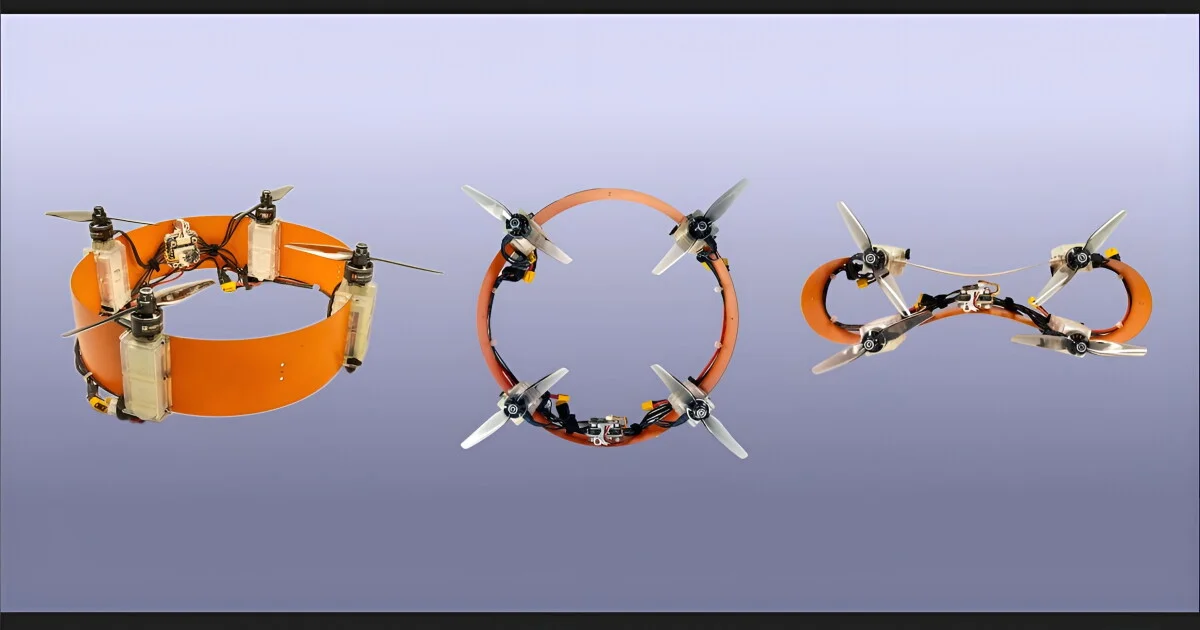
Most aircraft that hit an obstacle at high speed are damaged or destroyed, and drones are especially likely to break into pieces. A research team at ETH Zurich proposes another approach: make the body soft enough to absorb impacts while keeping enough stiffness in key directions. Their FlexiQuad not only keeps flying after hitting a wall, but can also shrink its body to slip through narrow gaps and grab objects.
Ring-shaped soft frame that springs back after impact
Conventional quadrotors usually consist of a rigid central body and four rigid rotor arms. This structure supports stable, precise flight, but in a high-speed impact the frame may be damaged, the aircraft may lose stability, or it may be destroyed outright. Although modern drones often use obstacle-avoidance systems to steer around obstacles in advance, the system may still react too late in high-speed or complex environments.
FlexiQuad's approach distributes the four rotors, battery and control electronics on a soft ring-shaped frame with an empty center. On impact, the frame bends first, absorbing part of the collision energy and spreading the remaining shock over a longer time; after the impact, the flexible structure springs back and the drone can keep flying.
Soft horizontally, stiff vertically
To be both impact-resistant and stable in flight, the key is anisotropic stiffness: the same structure exhibits different stiffness in different directions of force. Inspired by the wings of birds and insects, the team made FlexiQuad highly flexible in the horizontal direction, so it can bend sideways to absorb energy, while being noticeably stiffer in the vertical direction to provide structural support for transmitting rotor forces and controlled flight.
Luca Girardi, who took part in the development, said they focused on the stiffness distribution of the wings. Through this design, the drone combines structural flexibility with high flight performance, two qualities that are usually hard to achieve together.
It can shrink itself and also grasp objects
Because the body is essentially a deformable ring, FlexiQuad can squeeze itself narrower to pass through openings that would be too narrow for a full-size body. The team uses small servo motors and a pulley mechanism to pull the frame inward, reducing its width while maintaining controlled flight. In experiments, a 405-gram prototype successfully flew through an opening only 180 millimeters wide, about 70% of its normal width.
It can also deform passively using its own momentum to squeeze through narrow spaces without an extra folding mechanism. More interestingly, the same contraction action can be used for grasping: closing the hollow frame around an object grips it without a conventional mechanical gripper. In a demonstration, FlexiQuad grasped, transported and released a 136-gram soft first-aid kit. The team also showed its ability to lift payloads heavier than itself.
No compromise on speed and agility
Flexibility does not noticeably sacrifice flight performance. FlexiQuad has a top speed of about 80 km/h, and its linear and angular accelerations are comparable to those of conventional rigid quadrotors. According to the research published on arXiv, although the prototype is far more flexible than a conventional drone, its acceleration still exceeds three times gravity.
In crash tests, researchers deliberately flew it into obstacles at up to about 25 km/h, and the frame briefly deformed but the drone kept flying; in frontal impacts at up to 18 km/h, no structural or functional damage occurred.
Real-world scenarios and unresolved challenges
These capabilities suit environments where conventional drones struggle, such as inspecting narrow industrial spaces like ship ballast tanks, or search and rescue in collapsed buildings. A deformable body also lets a larger drone carry more sensors or batteries, sacrificing less payload capacity and endurance when passing through narrow openings.
However, moving from the lab to practical application still poses challenges. Flexibility makes flight control more complex. Girardi also acknowledged that rigid structures make precise control easier, one reason rigid frames have long dominated. When the frame springs back after a collision, it produces spring-like oscillations that may blur onboard camera images and affect positioning and navigation, so control systems must cope with changes in body shape and motion.
The team has used reinforcement learning to train FlexiQuad to perform reflex-like recovery maneuvers: after a collision, it uses onboard motion sensors to stabilize its attitude and then returns to autonomous flight. But reliable perception and autonomous navigation in complex real-world environments still need further development. Next steps include improving autonomy and exploring how flexible structures can aid perception and control. The team has filed a patent application for the structural design.
Source: ETH Zurich; paper: arXiv


Comments
0 comments